58th Annual Paphiopedilum Guild

Mark Your Calendars for this Special Event.

Expert Speaker Presentations

Slipper Orchid Displays • Orchid Sales
*New Location* Montecito Country Club *New Location*
902 Summit Road • Santa Barbara, CA

Saturday & Sunday, January 18-19, 2014

Featured Speakers:
Bill Goldner (Woodstream Orchids – Huntingtown, MD)
David Sorokowsky (Paph Paradise – Modesto, CA)
Dr. Harold Koopowitz (Editor Emeritus, Orchid Digest)
Chris Purver (Curator, Eric Young Orchid Foundation – Jersey, Channel Islands)
Plus a Presentation of the Latest
Paphiopedilum and Phragmipedium Awards by the American Orchid Society

Continental Breakfasts • Lunch • Dinner • Auction
Show & Sales setup at 7:30am Saturday
Lectures starting at 9:00am

Gift Certificates for Best Species and Best Hybrid

Full Event Registration: $95
(Guests of full registrants may accompany registrants to the BBQ & Auction(only) for $35 each)
Registration Closes January 12, 2014

This event is sponsored by Orchid Digest

Vandas

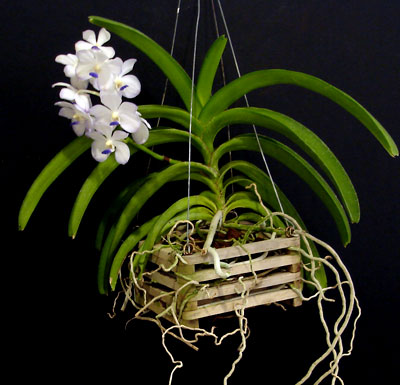
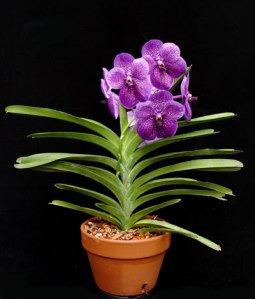
Vandas are impressive orchids that are relatively easy to grow.Vanda.in.cage
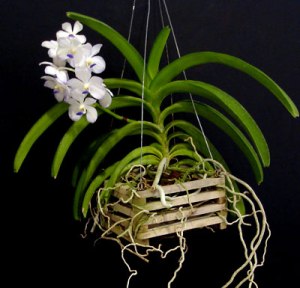
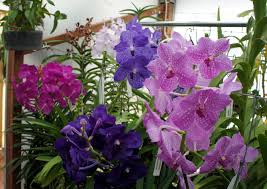
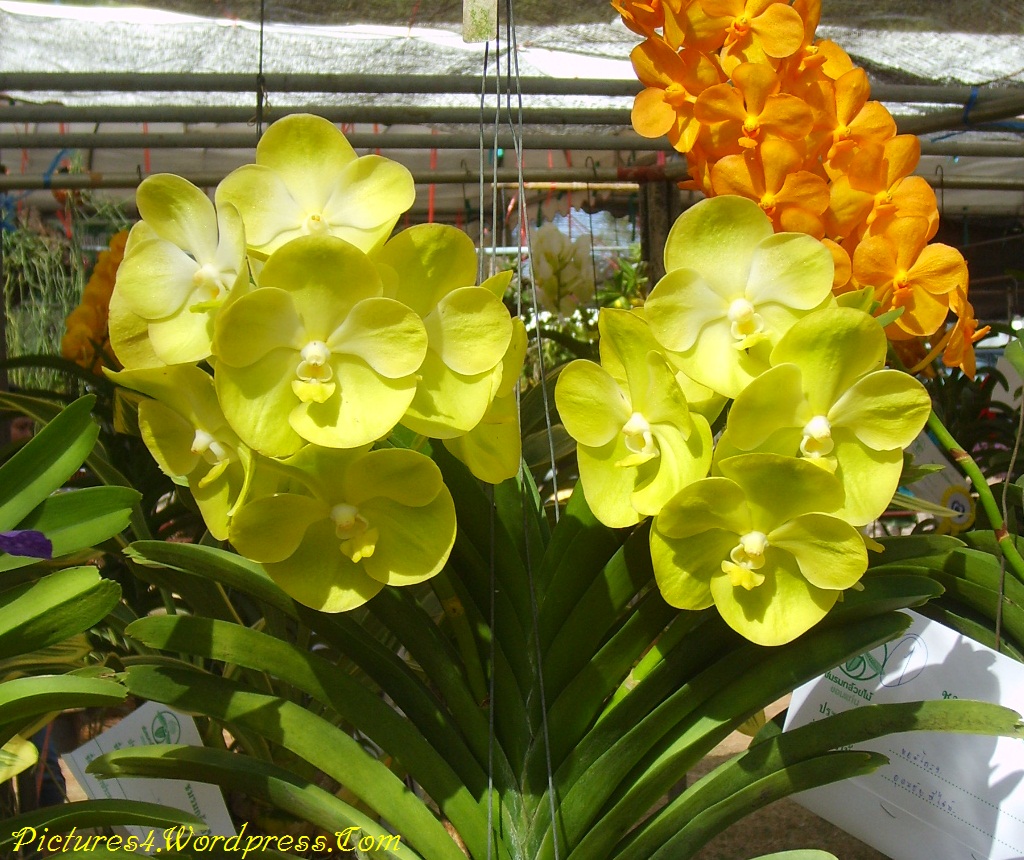
Vandas are monopodial, which means that the new leaves grow from the crown of the plant. This means the vanda is continually getting taller. Vanda flowers come in beautiful and superbly vibrant colors, including purples, blues, reds, oranges and yellows.  The flower spikes are very long and they usually have  8 to 10 blooms, which are located in a cluster at the end of the stem. The flower stem grow from the base of the leaves and can last for several weeks.   The long, heavy, flower laden stems can sometimes make the plants difficult to hang up and display at Orchid Shows or in your home, and may require additional support during blooming.

LIGHTING
Vandas need an abundance of light. They like either bright  morning  sun and/or  late afternoon sun, providing the sun exposure occurs gradually.  The plants need to adapt slowly to the any increase in lighting.  A good tip is to provide full morning sun whenever possible.  You don’t need a greenhouse to grow Vandas.   Any outside location with bright morning light will do, but  be careful while making the change to brighter light.  Try not to expose it to direct sun on the leaves,  just bright light.  Move it gradually, over the course of several weeks,  into brighter and brighter light and be careful to do it a little at at time.

I had my first Vanda for five years and it never bloomed.  I didn’t know what I was doing wrong.  It seemed healthy but wasn’t flowering.   I was fortunate that at one of our SFVOS meetings,  there was an expect who shared his knowledge about Vandas and explained to me that Vandas are happiest when they get very bright light.  The very next day, I moved my Vanda from the east side of my greenhouse to brighter west side of the greenhouse and I hung it up from the rafters at the top.      I am happy to report that since moving my Vanda to  brighter light, it has bloomed three times in the last year, and each bloom is more beautiful than the last.

TEMPERATURE
Vandas prefer to be kept on the warm side.  Vandas do best when when the nighttime temp is between 55 to 70°F and when daytime temperatures range between 65 to 95°F.vanda.multi.colors.

WATERING
The general “Rule of Thumb” for watering Vanda should be:  Hot temps = more water, and cooler temps = less water.

My Vanda is growing in a wooden cage with the roots all flowing out.  Some of the roots are 24 inches long. I have very little potting media in the cage, and most of the roots are loose and free, but many of them have attached themselves to the wooden cage itself.   I generally water mine about once a week, but when the temperatures are over  95 degrees and the humidity is low,  I give it a daily shower.

Remember that Vandas grown in baskets, without potting media, require more frequent watering.  In baskets, they may need to be watered daily during the summer. Always allow your Vanda to dry out between waterings. Try to water the plant early in the day, so that the foliage will be dry by nightfall.   If you are growing your Vanda in a greenhouse, and the humidity is constantly high you can use Physan 20 once a month (add it to your water) to prevent bacterial and fungal disease.

HUMIDITY
Although Vandas generally prefer 60% to 80% humidity, I can report that my greenhouse almost never has humidity this high.  If you can increase the humidity during the growing season, from early spring through late fall, your Vanda will thank you for it.  During the summer, watering should be supplemented with daily misting of the leaves. Humidity trays may be needed if your Vandas are growing indoors.

FERTILIZER
Vandas are heavy feeders. They must be fertilized on a regular basis! For best results, use nutrients every week. The experts recommend that you water the plants first with plain water, and then water the plant with a 1/4 strength nutrient solution.  Once a month water only with plain water to flush out any excess fertilizer.vanda_orchid_plant.in.pot
POTTING
Vandas may be grown in a medium to large sized Orchid Bark Mixture or you can grow them in wire or wooden baskets, which can then be  suspended (hung up) by a wire hanger attached to the cage.  Plants grown in baskets do not need to be repotted often as those in pots. Vandas grown in regular potting mix in pots should be repotted once every two years.  Repotting should be done in the spring.

It is almost impossible to extract a vanda from a “basket” or  “cage” once it has become attached to it.  When my vandas outgrow their smaller “baskets” I generally leave them in that basket and just place the entire small basket inside a larger basket.  I carefully thread the roots through the holes of the new basket and try not to damage the roots as much as possible.  One of my Vandas which is currently in an 8″ square wooden (redwood) cage has three smaller “cages” inside the basket from prior stages of  its life.   It does no harm to leave the old basket(s) there if they are in good shape and not starting to rot.

If your Vanda’s home “Basket or cage” begins to rot (which may also mean that you are overwatering) then you must re-pot for the health of the plant.  You will need to extract the roots as carefully as possible before re-potting it in its new home.  Soaking the roots for a couple of hours before attempting this will soften the plants roots and make it easier for you to handle them and try to get it out of its old pot.  Take your time, and save as many roots as possible.    Even if you lose a few roots, the plant should rebound and adapt to it’s new home in no time.
SELECTING YOUR VANDA

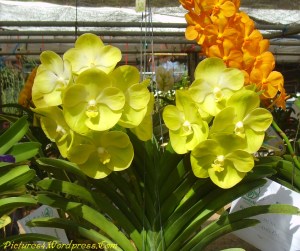
Vandas are becoming more available to hobby growers and can usually be found for sale at Orchid Shows and they are also available for purchase from many Orchid Growers websites.    You will probably want to start with a smaller specimen, as they are much easier to transport and would be much less expensive.   Your Vanda may need to get a bit bigger before it will bloom.   Your patience will be rewarded with a spectacular show of flowers.


PESTS  Common pests associated with Vandas are scale and spider mites.  Check your plant often to make sure it is pest free. Check our section on pest control if you notice any “freeloaders” hanging around your plant.  Vandas hung up from the rafters and/or suspended  are much less likely to get pests.  Best of luck with your Vandas and enjoy the spectacular blooms.
Orchid Collection Donated to SFVOS by the Tom Family of Eagle Rock.

Jack tom.photo

The SFVOS wa
s the recipient of a very generous donation of over 100 Cymbidium Orchid Plants by the Estate of Mr. Yee Quon (“Jack”) Tom. Jack Tom passed away on May 23rd, 2013.   Jack loved his orchids, and at one point had over 300 Orchid plants in his collection.  He took meticulous care of his prized collection and there were always blooming orchids in their beautiful hillside home in Eagle Rock.

Jack Tom was born eldest of seven in Guangdong Province, China on August 24, 1925. At 19, during China’s conflict with Japan, he left home to pursue his goals and ambitions. He was employed with various government agencies including Yuebei Iron Factory Accounting Department, Quijiang Wushi Training Department, and the Yangjiang County Taxation Department among others. After WW II, he worked in the Cashier’s Division at Guangzhou’s Sun Yet-Sen University. Mr. Tom arrived in Los Angeles in 1951 to work at his father’s restaurant. In 1956, along with friends, he opened the Taoyaun Restaurant in Chinatown.

In 1958, he returned to Hong Kong to marry Dora Chan. The newlyweds returned to Los Angeles to start a family. After the closure of Taoyaun Restaurant, Jack was employed as the chief chef at the famous Kowloon and Wan-Q Restaurants on the Westside. After 40 years in the restaurant business, Jack retired to focus on fruit trees and cultivating orchids. He especially enjoyed reading, listening to classical music, watching NBA basketball, and recreational cooking. In life, he always treated others amicably, with friendship. He took care of his wife, sons, and siblings with love. Jack believed he lived a good life, with a virtuous wife, with filial children, and experienced happiness and longevity. He is survived by and missed by Dora, wife of 55 years, his sons Stanley and Homer, daughter in law Joni, grandson Nathan, and his remaining brother and sisters in the U.S. and China.

We would like to thank the Tom Family for their generous donation.  I am sure Jack would be pleased to know that his beloved Orchids will be adopted and cared for by the members of The SFVOS.   If you would like to see a slideshow of Mr. Tom’s beautiful orchids, please visit http://www.tributes.com/show/95870991# and click on the photo of Jack  then select “Jack’s Orchids” from the photo albums available under the main photo.

The Endangered White Egret Orchid

Habenaria radiata is a small terrestrial orchid that grows in grassy wetlands throughout Japan, the Korean Peninsula, Russia and some parts of eastern China.  It is commonly known as the White Egret Flower.  It is also sometimes referred to as the  Fringed Orchid or Sagiso.

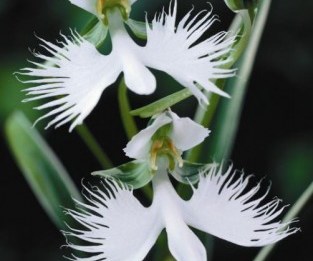
This orchid’s flower indeed looks much like a Snowy Egret with its wings wide open.   Japan is home to many snowy egrets and they often share the same habitats with this little flower.   This rare orchid has recently gained recognition around the world for its beauty, but ironically this species is now considered imperiled in the wild.

The leaves are similar to grass blades, between 5-20 cm long, and about 1 cm wide each. New leaves form every spring. Flowering commences in late July and peaks in August.  The flower stalk holds anywhere from 1 to 8 flowers, each being around 4 cm wide.  The lip, as well as the petals,  are pristine white, whereas the sepals are small and greenish.

whte.egret.orchid.sm.pot.imageThe plant grows from a small underground tuber, no more than a couple centimeters long,  Because this plant is deciduous the tuber serves as an energy source early in its growth cycle, allowing new leaves and a flower spike to form.

This species is in rapid decline over its entire range.  Over collection may be a contributing factor, but for the most part the loss has been due to habitat destruction.  In the distant past these plants grew in lowland bogs and marshes in the same areas where rice patties were later situated.   Rice cultivation rapidly increased, taking more and more of the unique habitat, which was then followed by urbanization, and in lowland areas this species became more and more rare in the wild.

Nowadays, Habenaria radiata exists mostly in upland bogs and seepage slopes in moderate to high mountains (over 500 meters elevation).  Because these areas are not considered suitable for agriculture this plant (along with other rare plants) has found its last remaining habitat in modern Japan.  While it still can be found on all of Japan’s main islands it is endangered throughout its entire range and is completely gone in some areas.

Most experienced orchid growers find it quite difficult to keep for more than a season or two.  This orchid requires conditions not easily duplicated outside it’s natural environment.   Because this orchid is endangered  one would hope that orchid growers would recognize the need to stop collecting them from the wild so we can keep as many of them alive in their native environments.    We should be grateful we can enjoy these orchids vicariously through photographs, and hope we can preserve these unique and beautiful orchids for generations to come. 

Psychopsis: The Butterfly Orchids

Psychopsis, abbreviated Psychp in horticultural trade, is a genus of only four species of orchids distributed from the West Indies and Costa Rica to Peru, where it grows on the trunks and branches of trees.

These orchids are particularly mysterious and are called butterfly orchidsThe flower moves in the wind, and mimics a female butterfly which attracts male butterflies to try and mate with it, thus pollinating the flower. It also might have a second trick.  The butterfly-like flower might attract a parasitic insect on the lookout for butterflies, or it fools a male butterfly into thinking it’s a female.

There’s even a fun word for it: pseudocopulation. Either way, the orchid succeeds in getting its seeds distributed to continue the life cycle. We got to see a hybrid butterfly orchid.

Psychopsis papilio (Lindley, 1825) H. G. Jones. 1975 Psychopsis mariposa, right.


Originally described by John Lindley as Oncidium papilio, it was removed to the genus Psychopsis by H. G. Jones (1975) in the Journal of the Barbados Museum Historical Society (p. 32). Caution: it’s still marketed occasionally under the old name by some vendors, and under both names by less scrupulous ones!

Psychopsis papilio(Ldl..) Jones. Photo: DSC_7781 04 May, 2006.

This species is a native of low-mountain forests in Trinidad, Venezuela, Colombia, Ecuador, and Peru. It resembles certain species of South American butterflies so well that males attempt to mate with it, and in doing so, pollinate it. P. papilio (Fig. 11) puts out a long rachis. This particular plant’s flower was held on one about 7.5 decimeters (about 30 inches) long, putting it well above the plant’s leaves where it may flutter lightly in a breeze and aide its butterfly mimicry. Another aid to butterfly mimicry is that flowers bloom successively; not a few at the same time.

Psychopsis papilio is often confused with P. kramerianum (see below) which is from Costa Rica, Panama, Ecuador, and Peru, but P. papilio has a bilaterally compressed peduncle lacking swollen nodes (P. kramerianum: peduncle terete), and the wings on the columns of each species are shaped differently.


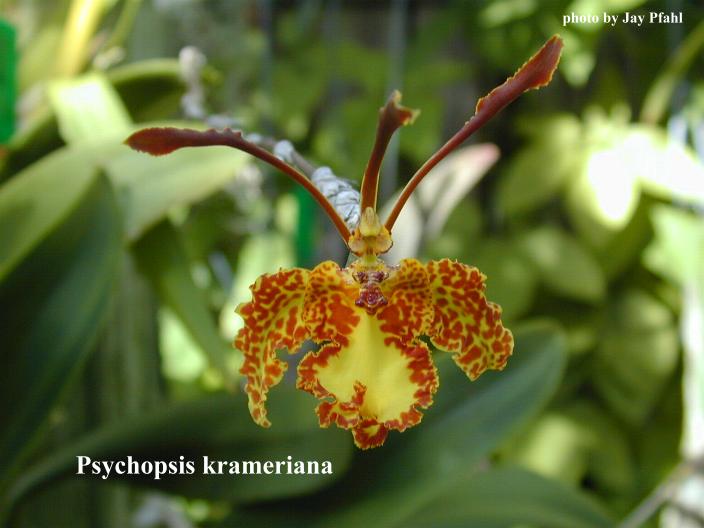
Kramer’s Psychopsis [German Orchid Gardner 1800’s]  (Image at top of article)psychkrameriana

Flower Size to 5″ [to 12.5 cm]

Found from Costa Rica, Panama, Colombia, Ecuador and Peru in tropical lowland and lower montane rainforests on large branches at altitudes of 50 to 1300 meters as a medium sized, hot to warm growing epiphyte with small dollar shaped, laterally compressed psuedobulbs subtended by imbricate bracts with spotted undersides of the single, apical, rigid, leathery, persistent, elliptic-oblong, acute, contracted into a short, folded petiole leaf that blooms on a 3′ [90 cm] long, erect, 1 to 2 flowered at a time, successive opening inflorescence with ovate-triangular bracts and large showy flowers. These inflorescence, if left alone can bloom for years so do not cut them as they also can produce plantlets.

AOS Book Review: The Orchid Whisperer

Book Review:
The Orchid Whisperer

By Bruce Rogers. 2012. Chronicle Books, San Francisco. Softcover. 143 pages. 75 color photographs.

The Orchid Whisperer is an eminently intelligent and attractive book for beginning orchid growers. While not actually advocating muttering at plants (at least not as an active growing tool), it presents plenty of easy-to-understand advice to get novice growers on the road to success. At the same time, author Bruce Rogers, a longtime commercial orchid man, makes it all so readable. Unlike some other “beginner”advice books, Rogers’ language is engaging and humorous, and strikes the right balance between being easy to read and needing a science degree to understand.

Rogers departs from the frequent novice- formula of analyzing conditions and buying plants to match those conditions. Instead, he suggests new growers buy what they like and then look for places inside their homes hospitable to the plants. His topics include practical advice on buying and selecting plants, mixes and repotting, light and temperature, watering and pests. In addition to the usual recommendations about beginning with phalaenopsis and cattleyas, he provides details on other genera such as miltoniopsis and reed-stem epidendrums. Rogers is unabashedly organic, offering green solutions to common pests like mealybugs, aphids and spider mites. He is also unabashedly optimistic, assuring his readers that their orchids can be kept blooming “no matter your experience level, budget, or locations.”

Then there’s Rogers’ humor:
“My advice is to learn how to repot cymbidiums, then find a job that pays well enough that you can hire someone to repot your cymbidiums.”

Graphically, the color photographs by Greg Allikas are excellent and the occasional checklist of tips practical and well organized. Rogers even adds a chapter on decorating with orchids, which is interesting enough to challenge even experienced growers to new levels of creativity. One more chart summarizing the light, water and temperature requirements of the included species might have been beneficial, but that’s available from other sources. The Orchid Whisperer is one to put on the holiday list for novice orchidists, or for those who may cuss while repotting.

— Sue Volek has been growing orchids as a hobby for more than 15 years, in San Diego, Washington, DC, and now Portland. She is on the board of the Oregon Orchid Society, an AOS affiliate, and has been an AOS member for more than 15 years.

.

Orchid “Apps” Now Available for the iPhone

Applications for smart phones, or “apps” as they are most often referred to, are changing the way we interact with our world on a daily basis.   Now there are Orchid “apps” for smart phones for Orchid lovers and/or growers which can help you keep track of all the orchids in your collections.

One increasingly popular “app” for the iPhone is the Orchid Notebook.  It helps you keep records on your orchids, their names, their appearance, and it offers helpful hints and tricks on how to grow them.  Orchid Notebook is easy to use.  Just type in the name or number of the Orchid, take a picture with your phone and the entire orchid collection appears on your phone.

Adding, deleting and updating your plants is easy. Orchid Notebook shows a running total of the plants in your collection for a quick reference.  This is particularly helpful when shopping for Orchids at shows and nurseries.

Key Features:
* Learn basic information about orchids
* Discover how to care for orchids
* Read about propagation techniques
* Enter information about the orchids in your collection into the database
* Enter photos of your orchids in your collection
* Build a wish list of the orchids you want to buy
* Export your collection and wish list information via a comma separated value (csv) file allowing the user to import the information into a spreadsheet
* Save a backup of your orchid collection datafile and share it with your other devices (iPhone/iPad)

Collection fields (in the Orchid Database):
* Genus name
* Species name
* Grex name
* Orchid Information – awards, flower color, fragrance, fragrance description, size of plant, size of flower
* Orchid Purchase Information – price, date, source
* Have or Want – the orchids you want are color coded in red
* Growing Conditions – temperature, lighting, water quantity, location
* Orchid details – Mounted, potted, size of pot, month last bloomed, date of last spike,date repotted
* Orchid notes
* Photos of orchid – allows up to 3 photos of each orchid entry

The app offers fairly accurate culture information for the most popular Orchid types including Cattleya, Dendrobium, Oncidium, Paphiopedilum, and Phalaenopsis.    The Orchid Notebook also offers information for uncommon types of orchids such as Brassavola, Encyclia, Phragmepedium, and Vanilla.   The Orchid Notebook includes sample pictures that are most helpful.  It does not yet contain information about Cymbidium, Miltonia, or Vanda.

It is not a perfect app by any means, but it is a step in the right direction.  No doubt, future versions of Orchid Notebook and other Orchid apps will follow that hopefully will be more full featured that this one.    One noted problem with this app, is that important botanical terms such as ‘species’, ‘hybrid’, and ‘variety’ are used interchangeably, even though their meanings are entirely different.  We hope that if enough Orchid Hobbyists comment on this app the authors will get the message and consult real orchid experts to help work out all the bugs of this program.

In the near future, as new orchid applications hit the market, hobbyists will have many more options available to enhance their orchid growing experience. The ‘free’ version of Orchid Notebook allows for five entries of an orchid collection and is just to allow you to try the app before you buy.  The full version of Orchid Notebook is only $2.99.   It is a shame that it is not yet available for the Android world, but if you have an iPhone this is still a good choice for the casual grower or someone just getting into orchids.

Pam Aitchison

Zygopetalum crinitum

Our featured orchid for August is the Zygopetalum crinitum.   It’s common name is “The Hairy Zygopetalum”.

These beautiful orchids are found at elevations of 600 to 1200 meters in the cool and moist mountain ranges of South America.  Most of them are found in Brazil in the mountains near Rio de Janeiro, and Sao Paulo.    They generally bloom from October through December and they produce a tall flower stalk which usually has eight to ten 9 cm flowers on it.    The flowers are fragrant, waxy and very long-lived.  The flowers are generally yellow-green with purple-brown streaks.  The flowers are also prized in cut-flower arrangements.

They have a reputation of being easy to grow for the home orchid enthusiast.  They like to be evenly moist at all times.  Do not let the potting media dry out completely.  They require medium to bright light, and when the light green leaves show some yellowing you can be assured that maximum light is being absorbed.  They require a medium to fine bark with some perlite added for moisture retention.

My Zygopetalum crinitum is in full bloom right now, so it must be confused about what time of year it is.  I got mine at the Santa Barbara Orchid Estate in 2008, and it has been reliably blooming every year since then.   Give this one a try.  You will be very happy you did.

Window Orchid Display Table Example

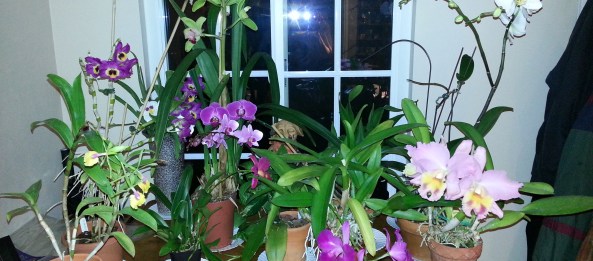
Everyone loves to display their blooming orchids in their homes.   Putting them all around the house adds a nice decorators touch to each room, but you can also put them all on one table for a more dramatic display.    Your friends and family will love to see what you have blooming, and the display is constantly changing throughout the year, so it never looks the same.

Here is a sample window display you can set up in your home to show off your blooming orchids.  Remember to put it in an East or North facing window.  No direct sunlight as it can burn the tender leaves of some orchids, such as Phalaenopsis.   Also the humidity inside homes is usually quite low, especially in the winter and the hot part of the summer when the air conditioner is running.  You can provide more humidity by using a humidity tray under the orchids.

To set up a homemade humidity tray,  place a shallow pan filled with gravel, decorative pebbles or lava rock on your table and fill with a small amount of water.  Set the orchid pots on top of the rocks, but never let them sit in standing water.  The pots should be above the water level at all times.

Keep your inside orchids clean by hosing off the entire plant in the bathtub or outside about once a month.  Do this in the morning so the plant will have time to dry off completely during the day.  Also never let water accumulate at the growing point on Phalaenopis (the point where the leaves connect at the center).   Water left in the crown can lead to crown rot, so dump out, and blow out any remaining water on the plant before putting back on the table.

Lastly a small fan for air circulation would be very helpful.  Put it on a timer and have it run for a few hours, on and off during the day.   Orchids love moving air.

Best of luck on your home display.