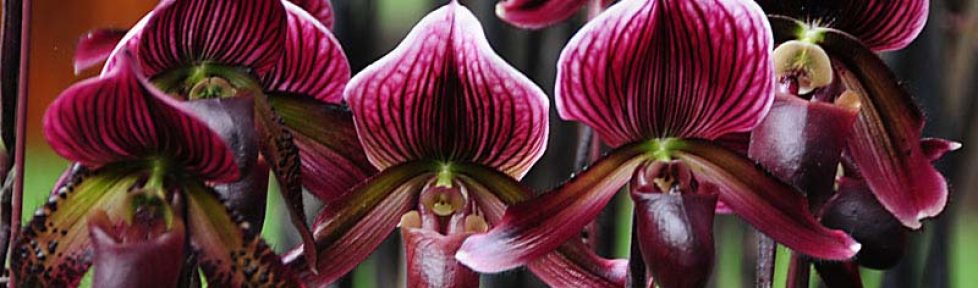

The Amazing Monkey Orchid

This gallery contains 4 photos.
Monkey Orchids These wonderful orchids come from the south-eastern Ecuadorian and Peruvian cloud forests from elevations of 3000 to 6000 feet and as such not many people throughout history got to see them. However, thanks to intrepid collectors we do … Continue reading
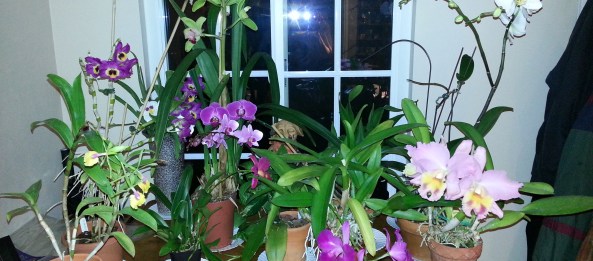
Window Orchid Display Table Example
Everyone loves to display their blooming orchids in their homes. Putting them all around the house adds a nice decorators touch to each room, but you can also put them all on one table for a more dramatic display. Your friends and family will love to see what you have blooming, and the display is constantly changing throughout the year, so it never looks the same.
Here is a sample window display you can set up in your home to show off your blooming orchids. Remember to put it in an East or North facing window. No direct sunlight as it can burn the tender leaves of some orchids, such as Phalaenopsis. Also the humidity inside homes is usually quite low, especially in the winter and the hot part of the summer when the air conditioner is running. You can provide more humidity by using a humidity tray under the orchids.
To set up a homemade humidity tray, place a shallow pan filled with gravel, decorative pebbles or lava rock on your table and fill with a small amount of water. Set the orchid pots on top of the rocks, but never let them sit in standing water. The pots should be above the water level at all times.
Keep your inside orchids clean by hosing off the entire plant in the bathtub or outside about once a month. Do this in the morning so the plant will have time to dry off completely during the day. Also never let water accumulate at the growing point on Phalaenopis (the point where the leaves connect at the center). Water left in the crown can lead to crown rot, so dump out, and blow out any remaining water on the plant before putting back on the table.
Lastly a small fan for air circulation would be very helpful. Put it on a timer and have it run for a few hours, on and off during the day. Orchids love moving air.
Best of luck on your home display.

Malibu Orchid Society Special Speaker July 16
Upcoming events at the Malibu Orchid Society
Bryce Augustine will speak on “Orchid Propagation”
7:00 pm. Tuesday, July 16th
Pacific Palisades Women’s Club
901 Haverford Avenue,
Pacific Palisades, CA 90272
I got a call from Melissa Lovelady tonight informing me that there is a special speaker this month at the Malibu Orchid Society. Melissa wanted me to pass on the information, so here it is. If any of you are interested in carpooling, contact me and I will put you in touch with other SFVOS members that may be going. Pam Aitchison (818) 406-5734.
Below is a excerpt from the Malibu Orchid Society Website.
Bryce Augustine is our speaker this month! Bryce is a long time member of the Santa Barbara Orchid society and an American Orchid Society judge. He owns and operates Monsoon Flora Orchids (monsoonorchids.com), which he established in 1991 and where he produces Paphs and Phrags in flasks, compots and seedlings.
He is a 20-year veteran of the American Orchid Society judging system as an accredited AOS judge and brought AOS judging to the central coast in April 2008 by creating a new Judging site in Santa Barbara where he served as its chairman for two years.
His presentations are always fun and informative and this coming meeting will be no exception. He will cover many different aspects of Orchids, covering how propagation from seedpods, rainforests, and your own backyard jungle are interrelated.

Many thanks to Jeanne Bain for years of wonderful service.
Please join us Wednesday night at our regular meeting when we will install our new officers and give thanks for those who have served so well and so long. Jeanne Bain is one of those special people. We hope to have the opportunity to let her know how much we appreciate her.

Don’t forget to wear your name tags!
Here is our Logo. When you become a member you get a name tag featuring this logo. When you come to the meetings and wear your name tag you can get a raffle ticket which entitles you to participate in the Plant Opportunity Table.
If you are lucky, and your number is called you may come home with a beautiful plant, just for wearing your name tag.
Installation of Officers will be at the July Meeting
Please join us for the Installation of our Officers and Directors for the upcoming year on Wednesday, July 3rd at our regular meeting immediately following our Guest Speaker, Winn Winmaw’s presentation.
We will be serving Cake and Ice Cream too.
This will take the place of the Installation Banquet normally held in August. Remember, for just this year, there will be no meeting in August.
Our normal meeting schedule will resume the first Wednesday in September.
We hope to see you all at the July meeting.
Our Featured Speaker for July 2013 Winn Winmaw
We are thrilled to announce that Winn Winmaw has agreed to return for an encore performance at our July meeting. We all enjoyed his PowerPoint presentation last time, and we are very lucky to get him to return so soon. His specialty is Vandaceous Orchids, as you may recall, but this time he will be surprising us with a new program he has created.
Winn was born in the Shan State of eastern Burma, where Cymbidium lowianum, Vanda coerulea and Paphiliopedilum charlesworthii are found abundantly in the wild. The first orchid that Winn collected from the forest floor was a dendrobium species when he was 7 years old. With this introduction to orchids, he began taking care of his family’s
extensive orchid collection. As an undergraduate, Winn studied physics at the University of Rangoon, where he
was also an active member of the Department of Botany’s Orchid Society. In 1988, Winn moved to the United
States and settled in Orange County.
Today he has a large orchid collection with many vandaceous species and varieties that he grows in a shade house and a greenhouse. Since 1995, he has been a member of the Newport Harbor Orchid Society. In recent years, he has made several trips back to Burma to explore and study orchids growing in nature.
AOS Monthly Checklist for July and August
Here are some helpful hints to care for your orchids in the hot summer months, courtesy of the AOS.
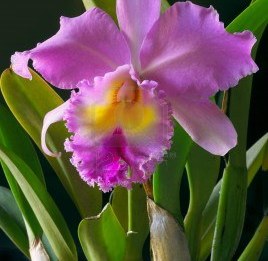
Cattleya
Cattleyas this month require careful attention to their watering and fertilizing needs owing to characteristically high temperatures. Evaporative cooling is a must in areas of the country where it is effective. Where it is not (the more humid regions), care needs to be paid to proper venting to keep temperatures within reason. Bottom vents in conjunction with top vents provide enough rising air-flow to help keep plants cool. Increased air flow lessens humidity and dries plants out more quickly, necessitating more frequent damping down and watering, in areas where high humidity is not a problem. Higher light and heat indicate more fertilizer. The growths your plants are making now are the source of this autumn, winter and spring’s blooms, so applying adequate fertilizer this month is the best way to ensure future blooms. Higher temperatures and humidity may also lead to fungal or bacterial rot problems, so it is important to closely observe your plants for any early indication of problems. Pests are also at a high point this month for the same reason
Paphiopedilum
Cooling and air circulation are especially critical in these two months to prevent stress and avoid dis-ease problems. Watering needs to be closely monitored to ensure that plants do not dry out. Warmer-growing hybrids will be at the peak of their blooming, with attention needing to be paid to staking of spikes. Look for water lodging in growths, which can rot emerging spikes and lead to the loss of the entire growth.
Phalaenopsis
Most, if not all, potting should be complete by now. This month and next are when these plants achieve their maximum growth. This growth will be that from which they set their spikes for the coming season. The more leaves the plants grow, the better potential for spiking will be realized. Growers in cooler areas such as the Pacific coast have the advantage this month, should they choose, of cooling for early season spikes. Lots of heat and light call for liberal applications of water and fertilizer.
Cymbidium
Summer can be the most rewarding season for cymbidiums. Growths should be coming strong now. The leaves of the new growths are best when they are broad and fairly stiff. The color should be a light green to nearly yellow. Early flowering varieties should be showing flower spikes, so move the plants into a cooler area with lower light. For mid-season varieties, lower the dosage of nitrogen to assist in spike initiation.
High-elevation Plants
For cooler-growing plants, such as masdevallias, other pleurothallids and the like, the next few months will be a challenge. During the hottest times, keep your plants more shaded and be sure to keep the humidity level much higher. Do not let plants dry out. Delay any potting until the weather cools.
Oncidium intergenerics :
Many of the intergeneric crosses between odontoglossums and oncidiums, such as Odontocidium, Wilsonara and Colmanara, will be blooming now. Take special care to train the spikes for best floral display. Keep plants under fairly shady conditions. Watch for snails and slugs.
Vandaceous:
Plants will be growing quickly now and really enjoying the hot humid days so similar to their native habitat. Watch for pests though, as many of these also enjoy the same con-ditions as the plants. Check flower spikes so that they can extend unimpeded for the best flower presentation later
The AOS thanks Ned Nash and James Rose for this essay
July Refreshments provided by your Society
For the July meeting refreshments will be provided by the SFVOS. We will be having Ice Cream and Cake.
Of course all members are welcome to contribute snacks at any meeting.
Remember, no Meeting in August, but we will return on September 2nd. We hope you all have a great summer.


You must be logged in to post a comment.