Vandas

Vandas are impressive orchids that are relatively easy to grow.Vanda.in.cage
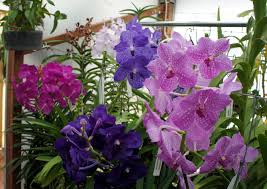
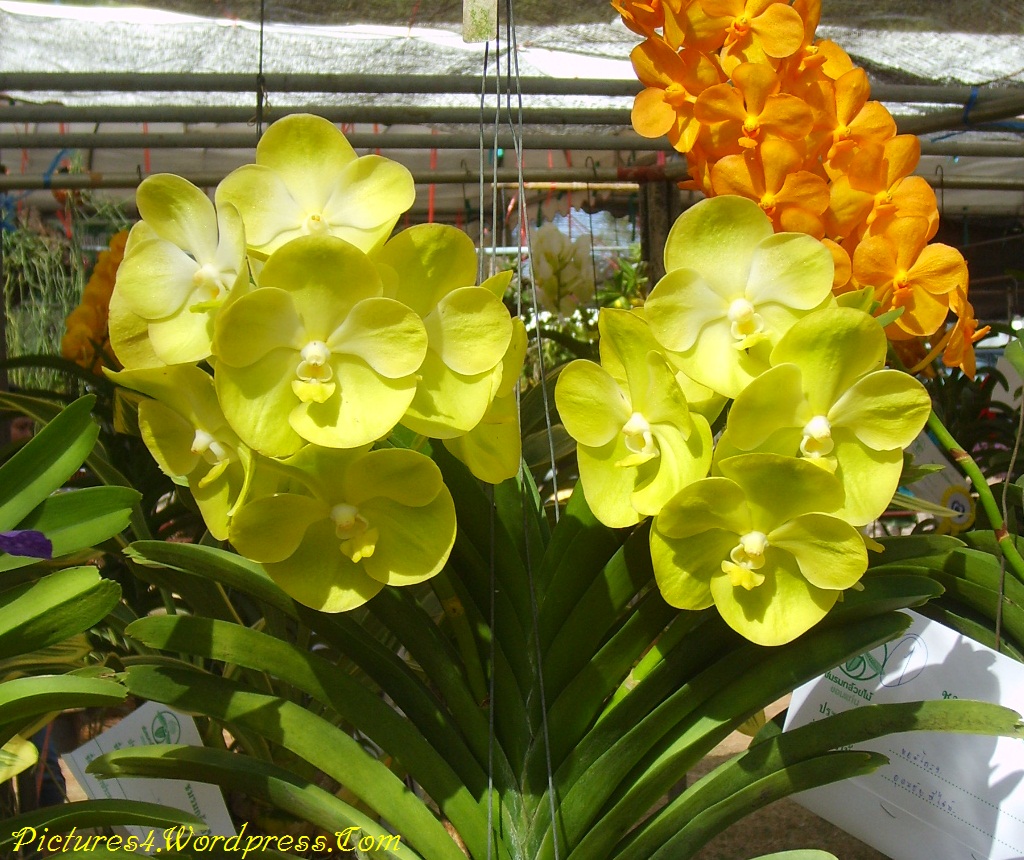
Vandas are monopodial, which means that the new leaves grow from the crown of the plant. This means the vanda is continually getting taller. Vanda flowers come in beautiful and superbly vibrant colors, including purples, blues, reds, oranges and yellows.  The flower spikes are very long and they usually have  8 to 10 blooms, which are located in a cluster at the end of the stem. The flower stem grow from the base of the leaves and can last for several weeks.   The long, heavy, flower laden stems can sometimes make the plants difficult to hang up and display at Orchid Shows or in your home, and may require additional support during blooming.

LIGHTING
Vandas need an abundance of light. They like either bright  morning  sun and/or  late afternoon sun, providing the sun exposure occurs gradually.  The plants need to adapt slowly to the any increase in lighting.  A good tip is to provide full morning sun whenever possible.  You don’t need a greenhouse to grow Vandas.   Any outside location with bright morning light will do, but  be careful while making the change to brighter light.  Try not to expose it to direct sun on the leaves,  just bright light.  Move it gradually, over the course of several weeks,  into brighter and brighter light and be careful to do it a little at at time.

I had my first Vanda for five years and it never bloomed.  I didn’t know what I was doing wrong.  It seemed healthy but wasn’t flowering.   I was fortunate that at one of our SFVOS meetings,  there was an expect who shared his knowledge about Vandas and explained to me that Vandas are happiest when they get very bright light.  The very next day, I moved my Vanda from the east side of my greenhouse to brighter west side of the greenhouse and I hung it up from the rafters at the top.      I am happy to report that since moving my Vanda to  brighter light, it has bloomed three times in the last year, and each bloom is more beautiful than the last.

TEMPERATURE
Vandas prefer to be kept on the warm side.  Vandas do best when when the nighttime temp is between 55 to 70°F and when daytime temperatures range between 65 to 95°F.vanda.multi.colors.
WATERING
The general “Rule of Thumb” for watering Vanda should be:  Hot temps = more water, and cooler temps = less water.

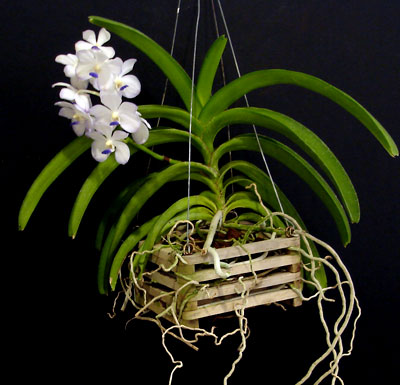
My Vanda is growing in a wooden cage with the roots all flowing out.  Some of the roots are 24 inches long. I have very little potting media in the cage, and most of the roots are loose and free, but many of them have attached themselves to the wooden cage itself.   I generally water mine about once a week, but when the temperatures are over  95 degrees and the humidity is low,  I give it a daily shower.

Remember that Vandas grown in baskets, without potting media, require more frequent watering.  In baskets, they may need to be watered daily during the summer. Always allow your Vanda to dry out between waterings. Try to water the plant early in the day, so that the foliage will be dry by nightfall.   If you are growing your Vanda in a greenhouse, and the humidity is constantly high you can use Physan 20 once a month (add it to your water) to prevent bacterial and fungal disease.

HUMIDITY
Although Vandas generally prefer 60% to 80% humidity, I can report that my greenhouse almost never has humidity this high.  If you can increase the humidity during the growing season, from early spring through late fall, your Vanda will thank you for it.  During the summer, watering should be supplemented with daily misting of the leaves. Humidity trays may be needed if your Vandas are growing indoors.

FERTILIZER
Vandas are heavy feeders. They must be fertilized on a regular basis! For best results, use nutrients every week. The experts recommend that you water the plants first with plain water, and then water the plant with a 1/4 strength nutrient solution.  Once a month water only with plain water to flush out any excess fertilizer.vanda_orchid_plant.in.pot

POTTING
Vandas may be grown in a medium to large sized Orchid Bark Mixture or you can grow them in wire or wooden baskets, which can then be  suspended (hung up) by a wire hanger attached to the cage.  Plants grown in baskets do not need to be repotted often as those in pots. Vandas grown in regular potting mix in pots should be repotted once every two years.  Repotting should be done in the spring.

It is almost impossible to extract a vanda from a “basket” or  “cage” once it has become attached to it.  When my vandas outgrow their smaller “baskets” I generally leave them in that basket and just place the entire small basket inside a larger basket.  I carefully thread the roots through the holes of the new basket and try not to damage the roots as much as possible.  One of my Vandas which is currently in an 8″ square wooden (redwood) cage has three smaller “cages” inside the basket from prior stages of  its life.   It does no harm to leave the old basket(s) there if they are in good shape and not starting to rot.

If your Vanda’s home “Basket or cage” begins to rot (which may also mean that you are overwatering) then you must re-pot for the health of the plant.  You will need to extract the roots as carefully as possible before re-potting it in its new home.  Soaking the roots for a couple of hours before attempting this will soften the plants roots and make it easier for you to handle them and try to get it out of its old pot.  Take your time, and save as many roots as possible.    Even if you lose a few roots, the plant should rebound and adapt to it’s new home in no time.
SELECTING YOUR VANDA

Vandas are becoming more available to hobby growers and can usually be found for sale at Orchid Shows and they are also available for purchase from many Orchid Growers websites.    You will probably want to start with a smaller specimen, as they are much easier to transport and would be much less expensive.   Your Vanda may need to get a bit bigger before it will bloom.   Your patience will be rewarded with a spectacular show of flowers.


PESTS  Common pests associated with Vandas are scale and spider mites.  Check your plant often to make sure it is pest free. Check our section on pest control if you notice any “freeloaders” hanging around your plant.  Vandas hung up from the rafters and/or suspended  are much less likely to get pests.  Best of luck with your Vandas and enjoy the spectacular blooms.

Orchid Collection Donated to SFVOS by the Tom Family of Eagle Rock.

Jack tom.photo

The SFVOS wa
s the recipient of a very generous donation of over 100 Cymbidium Orchid Plants by the Estate of Mr. Yee Quon (“Jack”) Tom. Jack Tom passed away on May 23rd, 2013.   Jack loved his orchids, and at one point had over 300 Orchid plants in his collection.  He took meticulous care of his prized collection and there were always blooming orchids in their beautiful hillside home in Eagle Rock.

Jack Tom was born eldest of seven in Guangdong Province, China on August 24, 1925. At 19, during China’s conflict with Japan, he left home to pursue his goals and ambitions. He was employed with various government agencies including Yuebei Iron Factory Accounting Department, Quijiang Wushi Training Department, and the Yangjiang County Taxation Department among others. After WW II, he worked in the Cashier’s Division at Guangzhou’s Sun Yet-Sen University. Mr. Tom arrived in Los Angeles in 1951 to work at his father’s restaurant. In 1956, along with friends, he opened the Taoyaun Restaurant in Chinatown.

In 1958, he returned to Hong Kong to marry Dora Chan. The newlyweds returned to Los Angeles to start a family. After the closure of Taoyaun Restaurant, Jack was employed as the chief chef at the famous Kowloon and Wan-Q Restaurants on the Westside. After 40 years in the restaurant business, Jack retired to focus on fruit trees and cultivating orchids. He especially enjoyed reading, listening to classical music, watching NBA basketball, and recreational cooking. In life, he always treated others amicably, with friendship. He took care of his wife, sons, and siblings with love. Jack believed he lived a good life, with a virtuous wife, with filial children, and experienced happiness and longevity. He is survived by and missed by Dora, wife of 55 years, his sons Stanley and Homer, daughter in law Joni, grandson Nathan, and his remaining brother and sisters in the U.S. and China.

We would like to thank the Tom Family for their generous donation.  I am sure Jack would be pleased to know that his beloved Orchids will be adopted and cared for by the members of The SFVOS.   If you would like to see a slideshow of Mr. Tom’s beautiful orchids, please visit http://www.tributes.com/show/95870991# and click on the photo of Jack  then select “Jack’s Orchids” from the photo albums available under the main photo.

Bryce Augustine on Orchid Propagation

Bryce Augustine will be our speaker for the San Fernando Valley Orchid Society meeting on Wednesday, October 2nd, 2013.  Bryce is a long time member of the Santa Barbara Orchid society and an American Orchid Society judge.   He owns and operates Monsoon Flora Orchids (monsoonorchids.com), which he established in 1991 and where he produces Paphs and Phrags in flasks, compots and seedlings.

He is a 20-year veteran of the American Orchid Society judging system as an accredited AOS judge and brought AOS judging to the central coast in April 2008 by creating a new Judging site in Santa Barbara where he served as its chairman for two years. His presentations are always fun and informative and this coming meeting will be no exception.  He will cover many different aspects of Orchids, covering how propagation from seedpods, rainforests, and your own backyard jungle are interrelated. If you were unable to attend the July meeting at the Malibu Orchid Society, you missed a real treat.  I went to that meeting, and learned a great deal.  He had a great PowerPoint presentation and a live demonstration.  After the meeting, I asked Mr. Augustine if he would come and talk to our group, and he graciously agreed.  He also brought some great items for the POT.  Some were “compots” of many small plants in a single pot.   Mark your calendars so won’t miss this fabulous speaker!

Orchid: How did it get it’s name?

Etymology:   The origin of the word Orchid.

The name comes from the Ancient Greek ὄρχις (órkhis), literally meaning “testicle“, because of the shape of the root. Carl Linnaeus classified the family as Orchidaceae.

Orchid was introduced in 1845 by John Lindley in School Botany, due to an incorrect attempt to extract the Latin stem (orchis) from Orchidaceae.

The Greek myth of Orchis explains the origin of the plants. Orchis, the son of a nymph and a satyr, came upon a festival of Dionysus (Bacchus) in the forest. He drank too much, and attempted to rape a priestess of Dionysus. For his insult, he was torn apart by the Bacchanalians. His father prayed for him to be restored, but the gods instead changed him into a flower.

These flowers were previously called OrchisSatyrion (Satyrion feminina), or “ballockwort”.

Orchidaceae are cosmopolitan, occurring in almost every habitat apart from glaciers.

The world’s richest concentration of orchid varieties is found in the tropics, mostly AsiaSouth America and Central America, but they are also found above the Arctic Circle, in southern Patagonia, and two species of Nematoceras on Macquarie Island at 54° south.


Source: Wikipedia
By pamaitchison Posted in Meetings

Orchid Fair in San Diego

San Diego International Orchid Fair

October 5-6, 2013

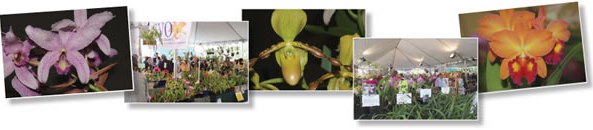
Plan to visit the San Diego Botanical Garden the weekend of Saturday, October 5th  through Sunday, October 6th to see the splendidly colorful San Diego International Orchid Fair.  Countless varieties of orchids grace the grounds, some in exhibits and some for sale.

Learn from the experts how to care for your newly purchased orchids at “Orchids 101,”our ongoing lectures on culture and care.

  • Where: The San Diego Botanic Garden

    The San Diego Botanic Garden, formerly Quail Botanical Gardens, is a botanical garden in Encinitas, California, USA.

  • Address: 230 Quail Gardens Dr, Encinitas, CA 92024

  • Phone: (760) 436-3036

  • Hours:  9:00am to 5:00pm

  • Cost:  The Orchid Show inside the garden is Free with paid daily admission to the Botanical Garden. (see details below)

    NOTE: You can also get in FREE if you have a membership at the San Diego Botanical Garden or any of the other 200 Gardens in the Reciprocal Membership program including the LA Arboretum, The American Horticultural Society or the American Orchid Society (must show Current Membership card).

    Adults $14
    Seniors, students, active military $10
    Children ages 3-12 $8
    Members; children ages 2 & under FREE
    Parking $2*    

    *Members park free.

Banner Photo: Ben Mach
Lycaste About first spring ‘Peter Sobel my delight’ FCC/AOS
The Grower is Helen Pfister

Montage Photos: Loren Batchman, left to right, L Anceps Tamiko, Sales Area,
Paph Veronique Bert, Sales Area, Pot Little Toshie ‘H & R’

By pamaitchison Posted in Meetings

September 4, 2013 Hydro Culture for Orchids

Our speaker for September is our own SFVOS member, Pamela Aitchison. Pam has been serving on our Board of Directors for the past year and is a regular contributor to our monthly newsletter. Pam is also the webmaster for our SFVOS website.

Pam is a Certified University of California Master Gardener, and has been teaching organic gardening for many years. She is on the teaching team that provides training to the new Master Gardener Candidates every year, and is a regular guest lecturer at California State University at Northridge (CSUN).

Pam has been growing orchids for more than 30 years, and her collection includes Cattleyas, Dendrobiums, Epidendrums, Miltonias & Miltoniopsis, Oncidiums, Maxillaria, Masdevillias, and Phalaenopsis, Cymbidiums, Vandas, Vanilla Orchids and Zygopetalums.

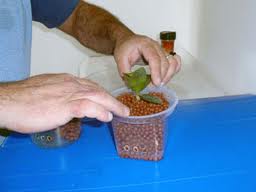
Pam will be sharing information about growing orchids the Hydro-Culture way, a method that is rapidly gaining popularity all over the world. Throw away what you think you know about hydroponics. This is completely different. The Hydro-Culture method of growing orchids is simple, requires much less work, less frequent watering and is much healthier for your orchids. Hydro Culture has been used for years by professional orchid growers and it certainly deserves consideration by beginners and experienced growers as well. Come join us on September 4th, to see her Power Point presentation and hands-on demonstration of the Hydro Culture method

AOS Monthly Checklist for September and October

Cattleya: Despite the shortening days and lowering angle of the sun, September can still be one of the hottest months. Water and fertilizer need to be in balance with heat and light. The alert grower will notice, however, that his or her plants are beginning to slow down a bit. Growths are maturing, and the sheaths are giving the promise of the next six-months’ bloom.

Check plants for potting needs for the last time this season. Any in dire need should be potted, even some that may be on the cusp, as there is just enough of the growing season left to allow the plants to establish before the days start to get really short and cold.

This is the month for purples derived from Cattleya labiata breeding to flower. If you are short on flowers, look into this group. There is nothing that can quite match this type for beauty and fragrance. They are easy to grow, too.

Plants summered outdoors should begin to be prepared to be brought back into the winter growing area. Clean the plants up and be on the lookout for any pests they may have picked up during the summer. Treat as necessary.

Cycnoches:This little-known and under-appreciated genus, which can have male or female flowers, is at its best in the autumn. Two of the spectacular varieties are Cycnoches loddigesii, with its large brown flowers resembling a prehistoric bird, and Cycnoches chlorochilon, the swan orchid. This last one has large, fragrant green flowers. The biggest problem, culturally, will be red spider mite infestations that require immediate attention. Plants are quite seasonal, requiring heavy watering in the growing season and then a drier dormant winter season.

Cymbidium: Summer can be the most rewarding season for cymbidiums. Growths should be coming strong now. The leaves of the new growths are best when they are broad and fairly stiff. The color should be a light green to nearly yellow. Early flowering varieties should be showing flower spikes, so move the plants into a cooler area with lower light. For mid-season varieties, lower the dosage of nitrogen to assist in spike initiation.

Dendrobium:This is a good season for hybrids of the Dendrobium phalaenopsis and Dendrobium canaliculatum types. Both are capable of putting on tremendous shows of long-lasting flowers. Fertilize with a low-nitrogen formula to promote the best flowers. Dendrobium phalaenopsis can get tall and top heavy, suggesting an attractive and heavy container would be appropriate for this type.

Rhynchostele bictoniensis:Both Rhynchostele bictoniensis and its hybrids bloom in this season. Rhynchostele bictoniensis, formerly known as Lemboglossum, Odontoglossum) is a showy species from Mexico that has three different color forms: sulphureum (green with white lip), album (brown with white lip) and roseum (brown with a pink lip). It is a vigorous grower with tall inflorescences of many flowers, and imparts to its progeny (as seen in Odcdm. Bittersweet and Odm. bicross) ease of culture, warmth tolerance and eye-catching patterns. They make a prime candidate for odontoglossum beginners and advanced alike.

Paphiopedilum: Standard, green-leaved paphiopedilums begin to show their bloom sheaths this month. Late-season heat waves can blast these early sheaths, so be observant about proper cooling and air circulation. As with the rest of your plants that may have been summered outdoors, it is time to prepare for their move inside. Clean each plant and implement pest-control practices. Repotting, if necessary, is appropriate.

Phalaenopsis: The bulk of this season’s growth is being ripened this month, with growers in cooler climates seeing the first emerging inflorescences. Some night heating may be necessary in the cooler areas. Begin to watch watering more carefully, and reduce feeding proportionately with reduced watering needs. An extra dose of phosphorus and potassium, such as a bloom-booster or high-acid-type fertilizer, is beneficial.
Rossioglossum grande: Once known as Odontoglossum grande, this is a spectacular orchid with six to eight flowers up to 8 inches across. Often known as the tiger orchid, it has bright golden yellow flowers heavily marked with chestnut brown barring. The plants are beautiful with a grey-green cast to the foliage, which is borne on succulent pseudobulbs. It prefers hot and wet summers with cooler, even down to 40 F, dry winters. Grow under filtered light. Watch for snails and slugs that eat the flowers, pseudobulbs and leaves.

The AOS thanks Ned Nash and James Rose for this essay.

By pamaitchison Posted in Meetings