Bryce Augustine on Orchid Propagation

Bryce Augustine will be our speaker for the San Fernando Valley Orchid Society meeting on Wednesday, October 2nd, 2013.  Bryce is a long time member of the Santa Barbara Orchid society and an American Orchid Society judge.   He owns and operates Monsoon Flora Orchids (monsoonorchids.com), which he established in 1991 and where he produces Paphs and Phrags in flasks, compots and seedlings.

He is a 20-year veteran of the American Orchid Society judging system as an accredited AOS judge and brought AOS judging to the central coast in April 2008 by creating a new Judging site in Santa Barbara where he served as its chairman for two years. His presentations are always fun and informative and this coming meeting will be no exception.  He will cover many different aspects of Orchids, covering how propagation from seedpods, rainforests, and your own backyard jungle are interrelated. If you were unable to attend the July meeting at the Malibu Orchid Society, you missed a real treat.  I went to that meeting, and learned a great deal.  He had a great PowerPoint presentation and a live demonstration.  After the meeting, I asked Mr. Augustine if he would come and talk to our group, and he graciously agreed.  He also brought some great items for the POT.  Some were “compots” of many small plants in a single pot.   Mark your calendars so won’t miss this fabulous speaker!

Orchid “Apps” Now Available for the iPhone

Applications for smart phones, or “apps” as they are most often referred to, are changing the way we interact with our world on a daily basis.   Now there are Orchid “apps” for smart phones for Orchid lovers and/or growers which can help you keep track of all the orchids in your collections.

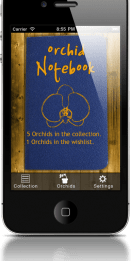
One increasingly popular “app” for the iPhone is the Orchid Notebook.  It helps you keep records on your orchids, their names, their appearance, and it offers helpful hints and tricks on how to grow them.  Orchid Notebook is easy to use.  Just type in the name or number of the Orchid, take a picture with your phone and the entire orchid collection appears on your phone.

Adding, deleting and updating your plants is easy. Orchid Notebook shows a running total of the plants in your collection for a quick reference.  This is particularly helpful when shopping for Orchids at shows and nurseries.

Key Features:
* Learn basic information about orchids
* Discover how to care for orchids
* Read about propagation techniques
* Enter information about the orchids in your collection into the database
* Enter photos of your orchids in your collection
* Build a wish list of the orchids you want to buy
* Export your collection and wish list information via a comma separated value (csv) file allowing the user to import the information into a spreadsheet
* Save a backup of your orchid collection datafile and share it with your other devices (iPhone/iPad)

Collection fields (in the Orchid Database):
* Genus name
* Species name
* Grex name
* Orchid Information – awards, flower color, fragrance, fragrance description, size of plant, size of flower
* Orchid Purchase Information – price, date, source
* Have or Want – the orchids you want are color coded in red
* Growing Conditions – temperature, lighting, water quantity, location
* Orchid details – Mounted, potted, size of pot, month last bloomed, date of last spike,date repotted
* Orchid notes
* Photos of orchid – allows up to 3 photos of each orchid entry

The app offers fairly accurate culture information for the most popular Orchid types including Cattleya, Dendrobium, Oncidium, Paphiopedilum, and Phalaenopsis.    The Orchid Notebook also offers information for uncommon types of orchids such as Brassavola, Encyclia, Phragmepedium, and Vanilla.   The Orchid Notebook includes sample pictures that are most helpful.  It does not yet contain information about Cymbidium, Miltonia, or Vanda.

It is not a perfect app by any means, but it is a step in the right direction.  No doubt, future versions of Orchid Notebook and other Orchid apps will follow that hopefully will be more full featured that this one.    One noted problem with this app, is that important botanical terms such as ‘species’, ‘hybrid’, and ‘variety’ are used interchangeably, even though their meanings are entirely different.  We hope that if enough Orchid Hobbyists comment on this app the authors will get the message and consult real orchid experts to help work out all the bugs of this program.

In the near future, as new orchid applications hit the market, hobbyists will have many more options available to enhance their orchid growing experience. The ‘free’ version of Orchid Notebook allows for five entries of an orchid collection and is just to allow you to try the app before you buy.  The full version of Orchid Notebook is only $2.99.   It is a shame that it is not yet available for the Android world, but if you have an iPhone this is still a good choice for the casual grower or someone just getting into orchids.

Pam Aitchison
September 4, 2013 Hydro Culture for Orchids

Our speaker for September is our own SFVOS member, Pamela Aitchison. Pam has been serving on our Board of Directors for the past year and is a regular contributor to our monthly newsletter. Pam is also the webmaster for our SFVOS website.

Pam is a Certified University of California Master Gardener, and has been teaching organic gardening for many years. She is on the teaching team that provides training to the new Master Gardener Candidates every year, and is a regular guest lecturer at California State University at Northridge (CSUN).

Pam has been growing orchids for more than 30 years, and her collection includes Cattleyas, Dendrobiums, Epidendrums, Miltonias & Miltoniopsis, Oncidiums, Maxillaria, Masdevillias, and Phalaenopsis, Cymbidiums, Vandas, Vanilla Orchids and Zygopetalums.

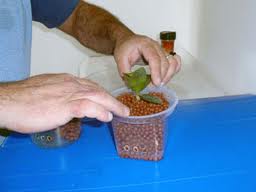
Pam will be sharing information about growing orchids the Hydro-Culture way, a method that is rapidly gaining popularity all over the world. Throw away what you think you know about hydroponics. This is completely different. The Hydro-Culture method of growing orchids is simple, requires much less work, less frequent watering and is much healthier for your orchids. Hydro Culture has been used for years by professional orchid growers and it certainly deserves consideration by beginners and experienced growers as well. Come join us on September 4th, to see her Power Point presentation and hands-on demonstration of the Hydro Culture method

Zygopetalum crinitum

Our featured orchid for August is the Zygopetalum crinitum.   It’s common name is “The Hairy Zygopetalum”.

These beautiful orchids are found at elevations of 600 to 1200 meters in the cool and moist mountain ranges of South America.  Most of them are found in Brazil in the mountains near Rio de Janeiro, and Sao Paulo.    They generally bloom from October through December and they produce a tall flower stalk which usually has eight to ten 9 cm flowers on it.    The flowers are fragrant, waxy and very long-lived.  The flowers are generally yellow-green with purple-brown streaks.  The flowers are also prized in cut-flower arrangements.

They have a reputation of being easy to grow for the home orchid enthusiast.  They like to be evenly moist at all times.  Do not let the potting media dry out completely.  They require medium to bright light, and when the light green leaves show some yellowing you can be assured that maximum light is being absorbed.  They require a medium to fine bark with some perlite added for moisture retention.

My Zygopetalum crinitum is in full bloom right now, so it must be confused about what time of year it is.  I got mine at the Santa Barbara Orchid Estate in 2008, and it has been reliably blooming every year since then.   Give this one a try.  You will be very happy you did.

Window Orchid Display Table Example

Everyone loves to display their blooming orchids in their homes.   Putting them all around the house adds a nice decorators touch to each room, but you can also put them all on one table for a more dramatic display.    Your friends and family will love to see what you have blooming, and the display is constantly changing throughout the year, so it never looks the same.

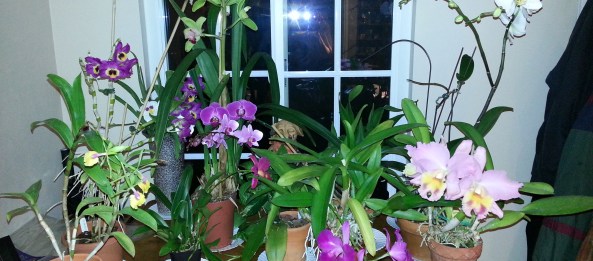
Here is a sample window display you can set up in your home to show off your blooming orchids.  Remember to put it in an East or North facing window.  No direct sunlight as it can burn the tender leaves of some orchids, such as Phalaenopsis.   Also the humidity inside homes is usually quite low, especially in the winter and the hot part of the summer when the air conditioner is running.  You can provide more humidity by using a humidity tray under the orchids.

To set up a homemade humidity tray,  place a shallow pan filled with gravel, decorative pebbles or lava rock on your table and fill with a small amount of water.  Set the orchid pots on top of the rocks, but never let them sit in standing water.  The pots should be above the water level at all times.

Keep your inside orchids clean by hosing off the entire plant in the bathtub or outside about once a month.  Do this in the morning so the plant will have time to dry off completely during the day.  Also never let water accumulate at the growing point on Phalaenopis (the point where the leaves connect at the center).   Water left in the crown can lead to crown rot, so dump out, and blow out any remaining water on the plant before putting back on the table.

Lastly a small fan for air circulation would be very helpful.  Put it on a timer and have it run for a few hours, on and off during the day.   Orchids love moving air.

Best of luck on your home display.

Malibu Orchid Society Special Speaker July 16

Upcoming events at the Malibu Orchid Society

Bryce Augustine will speak on “Orchid Propagation”

7:00 pm. Tuesday, July 16th

Pacific Palisades Women’s Club
901 Haverford Avenue,
Pacific Palisades, CA 90272

I got a call from Melissa Lovelady tonight informing me that there is a special speaker this month at the Malibu Orchid Society.  Melissa wanted me to pass on the information, so here it is.   If any of you are interested in carpooling,  contact me and I will put you in touch with other SFVOS members that may be going.  Pam Aitchison (818) 406-5734.

Below is a excerpt from the Malibu Orchid Society Website.

Bryce Augustine is our speaker this month!  Bryce is a long time member of the Santa Barbara Orchid society and an American Orchid Society judge.   He owns and operates Monsoon Flora Orchids (monsoonorchids.com), which he established in 1991 and where he produces Paphs and Phrags in flasks, compots and seedlings.
He is a 20-year veteran of the American Orchid Society judging system as an accredited AOS judge and brought AOS judging to the central coast in April 2008 by creating a new Judging site in Santa Barbara where he served as its chairman for two years.

His presentations are always fun and informative and this coming meeting will be no exception.  He will cover many different aspects of Orchids, covering how propagation from seedpods, rainforests, and your own backyard jungle are interrelated.

Our Featured Speaker for July 2013 Winn Winmaw

We are thrilled to announce that Winn Winmaw has agreed to return for an encore performance at our July meeting. We all enjoyed his PowerPoint presentation last time, and we are very lucky to get him to return so soon. His specialty is Vandaceous Orchids, as you may recall, but this time he will be surprising us with a new program he has created.
Winn was born in the Shan State of eastern Burma, where Cymbidium lowianum, Vanda coerulea and Paphiliopedilum charlesworthii are found abundantly in the wild. The first orchid that Winn collected from the forest floor was a dendrobium species when he was 7 years old. With this introduction to orchids, he began taking care of his family’s
extensive orchid collection. As an undergraduate, Winn studied physics at the University of Rangoon, where he
was also an active member of the Department of Botany’s Orchid Society. In 1988, Winn moved to the United
States and settled in Orange County.

Today he has a large orchid collection with many vandaceous species and varieties that he grows in a shade house and a greenhouse. Since 1995, he has been a member of the Newport Harbor Orchid Society. In recent years, he has made several trips back to Burma to explore and study orchids growing in nature.