Applications for smart phones, or “apps” as they are most often referred to, are changing the way we interact with our world on a daily basis. Now there are Orchid “apps” for smart phones for Orchid lovers and/or growers which can help you keep track of all the orchids in your collections.
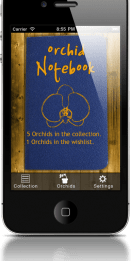
One increasingly popular “app” for the iPhone is the Orchid Notebook. It helps you keep records on your orchids, their names, their appearance, and it offers helpful hints and tricks on how to grow them. Orchid Notebook is easy to use. Just type in the name or number of the Orchid, take a picture with your phone and the entire orchid collection appears on your phone.
Adding, deleting and updating your plants is easy. Orchid Notebook shows a running total of the plants in your collection for a quick reference. This is particularly helpful when shopping for Orchids at shows and nurseries.
Key Features:
* Learn basic information about orchids
* Discover how to care for orchids
* Read about propagation techniques
* Enter information about the orchids in your collection into the database
* Enter photos of your orchids in your collection
* Build a wish list of the orchids you want to buy
* Export your collection and wish list information via a comma separated value (csv) file allowing the user to import the information into a spreadsheet
* Save a backup of your orchid collection datafile and share it with your other devices (iPhone/iPad)
Collection fields (in the Orchid Database):
* Genus name
* Species name
* Grex name
* Orchid Information – awards, flower color, fragrance, fragrance description, size of plant, size of flower
* Orchid Purchase Information – price, date, source
* Have or Want – the orchids you want are color coded in red
* Growing Conditions – temperature, lighting, water quantity, location
* Orchid details – Mounted, potted, size of pot, month last bloomed, date of last spike,date repotted
* Orchid notes
* Photos of orchid – allows up to 3 photos of each orchid entry
The app offers fairly accurate culture information for the most popular Orchid types including Cattleya, Dendrobium, Oncidium, Paphiopedilum, and Phalaenopsis. The Orchid Notebook also offers information for uncommon types of orchids such as Brassavola, Encyclia, Phragmepedium, and Vanilla. The Orchid Notebook includes sample pictures that are most helpful. It does not yet contain information about Cymbidium, Miltonia, or Vanda.
It is not a perfect app by any means, but it is a step in the right direction. No doubt, future versions of Orchid Notebook and other Orchid apps will follow that hopefully will be more full featured that this one. One noted problem with this app, is that important botanical terms such as ‘species’, ‘hybrid’, and ‘variety’ are used interchangeably, even though their meanings are entirely different. We hope that if enough Orchid Hobbyists comment on this app the authors will get the message and consult real orchid experts to help work out all the bugs of this program.
In the near future, as new orchid applications hit the market, hobbyists will have many more options available to enhance their orchid growing experience. The ‘free’ version of Orchid Notebook allows for five entries of an orchid collection and is just to allow you to try the app before you buy. The full version of Orchid Notebook is only $2.99. It is a shame that it is not yet available for the Android world, but if you have an iPhone this is still a good choice for the casual grower or someone just getting into orchids.
Pam Aitchison

 San Fernando Valley Orchid Society