Psychopsis: The Butterfly Orchids

Psychopsis, abbreviated Psychp in horticultural trade, is a genus of only four species of orchids distributed from the West Indies and Costa Rica to Peru, where it grows on the trunks and branches of trees.

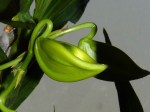
These orchids are particularly mysterious and are called butterfly orchidsThe flower moves in the wind, and mimics a female butterfly which attracts male butterflies to try and mate with it, thus pollinating the flower. It also might have a second trick.  The butterfly-like flower might attract a parasitic insect on the lookout for butterflies, or it fools a male butterfly into thinking it’s a female.

There’s even a fun word for it: pseudocopulation. Either way, the orchid succeeds in getting its seeds distributed to continue the life cycle. We got to see a hybrid butterfly orchid.

Psychopsis papilio (Lindley, 1825) H. G. Jones. 1975 Psychopsis mariposa, right.


Originally described by John Lindley as Oncidium papilio, it was removed to the genus Psychopsis by H. G. Jones (1975) in the Journal of the Barbados Museum Historical Society (p. 32). Caution: it’s still marketed occasionally under the old name by some vendors, and under both names by less scrupulous ones!

Psychopsis papilio(Ldl..) Jones. Photo: DSC_7781 04 May, 2006.

This species is a native of low-mountain forests in Trinidad, Venezuela, Colombia, Ecuador, and Peru. It resembles certain species of South American butterflies so well that males attempt to mate with it, and in doing so, pollinate it. P. papilio (Fig. 11) puts out a long rachis. This particular plant’s flower was held on one about 7.5 decimeters (about 30 inches) long, putting it well above the plant’s leaves where it may flutter lightly in a breeze and aide its butterfly mimicry. Another aid to butterfly mimicry is that flowers bloom successively; not a few at the same time.

Psychopsis papilio is often confused with P. kramerianum (see below) which is from Costa Rica, Panama, Ecuador, and Peru, but P. papilio has a bilaterally compressed peduncle lacking swollen nodes (P. kramerianum: peduncle terete), and the wings on the columns of each species are shaped differently.


Kramer’s Psychopsis [German Orchid Gardner 1800’s]  (Image at top of article)psychkrameriana
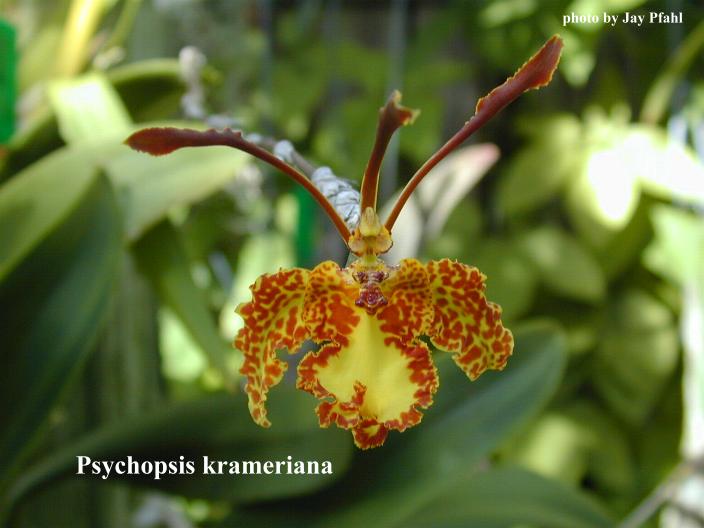
Flower Size to 5″ [to 12.5 cm]

Found from Costa Rica, Panama, Colombia, Ecuador and Peru in tropical lowland and lower montane rainforests on large branches at altitudes of 50 to 1300 meters as a medium sized, hot to warm growing epiphyte with small dollar shaped, laterally compressed psuedobulbs subtended by imbricate bracts with spotted undersides of the single, apical, rigid, leathery, persistent, elliptic-oblong, acute, contracted into a short, folded petiole leaf that blooms on a 3′ [90 cm] long, erect, 1 to 2 flowered at a time, successive opening inflorescence with ovate-triangular bracts and large showy flowers. These inflorescence, if left alone can bloom for years so do not cut them as they also can produce plantlets.

AOS Book Review: The Orchid Whisperer

Book Review:
The Orchid Whisperer

By Bruce Rogers. 2012. Chronicle Books, San Francisco. Softcover. 143 pages. 75 color photographs.

The Orchid Whisperer is an eminently intelligent and attractive book for beginning orchid growers. While not actually advocating muttering at plants (at least not as an active growing tool), it presents plenty of easy-to-understand advice to get novice growers on the road to success. At the same time, author Bruce Rogers, a longtime commercial orchid man, makes it all so readable. Unlike some other “beginner”advice books, Rogers’ language is engaging and humorous, and strikes the right balance between being easy to read and needing a science degree to understand.

Rogers departs from the frequent novice- formula of analyzing conditions and buying plants to match those conditions. Instead, he suggests new growers buy what they like and then look for places inside their homes hospitable to the plants. His topics include practical advice on buying and selecting plants, mixes and repotting, light and temperature, watering and pests. In addition to the usual recommendations about beginning with phalaenopsis and cattleyas, he provides details on other genera such as miltoniopsis and reed-stem epidendrums. Rogers is unabashedly organic, offering green solutions to common pests like mealybugs, aphids and spider mites. He is also unabashedly optimistic, assuring his readers that their orchids can be kept blooming “no matter your experience level, budget, or locations.”

Then there’s Rogers’ humor:
“My advice is to learn how to repot cymbidiums, then find a job that pays well enough that you can hire someone to repot your cymbidiums.”

Graphically, the color photographs by Greg Allikas are excellent and the occasional checklist of tips practical and well organized. Rogers even adds a chapter on decorating with orchids, which is interesting enough to challenge even experienced growers to new levels of creativity. One more chart summarizing the light, water and temperature requirements of the included species might have been beneficial, but that’s available from other sources. The Orchid Whisperer is one to put on the holiday list for novice orchidists, or for those who may cuss while repotting.

— Sue Volek has been growing orchids as a hobby for more than 15 years, in San Diego, Washington, DC, and now Portland. She is on the board of the Oregon Orchid Society, an AOS affiliate, and has been an AOS member for more than 15 years.

.

Bryce Augustine on Orchid Propagation

Bryce Augustine will be our speaker for the San Fernando Valley Orchid Society meeting on Wednesday, October 2nd, 2013.  Bryce is a long time member of the Santa Barbara Orchid society and an American Orchid Society judge.   He owns and operates Monsoon Flora Orchids (monsoonorchids.com), which he established in 1991 and where he produces Paphs and Phrags in flasks, compots and seedlings.

He is a 20-year veteran of the American Orchid Society judging system as an accredited AOS judge and brought AOS judging to the central coast in April 2008 by creating a new Judging site in Santa Barbara where he served as its chairman for two years. His presentations are always fun and informative and this coming meeting will be no exception.  He will cover many different aspects of Orchids, covering how propagation from seedpods, rainforests, and your own backyard jungle are interrelated. If you were unable to attend the July meeting at the Malibu Orchid Society, you missed a real treat.  I went to that meeting, and learned a great deal.  He had a great PowerPoint presentation and a live demonstration.  After the meeting, I asked Mr. Augustine if he would come and talk to our group, and he graciously agreed.  He also brought some great items for the POT.  Some were “compots” of many small plants in a single pot.   Mark your calendars so won’t miss this fabulous speaker!

Malibu Orchid Society Special Speaker July 16

Upcoming events at the Malibu Orchid Society

Bryce Augustine will speak on “Orchid Propagation”

7:00 pm. Tuesday, July 16th

Pacific Palisades Women’s Club
901 Haverford Avenue,
Pacific Palisades, CA 90272

I got a call from Melissa Lovelady tonight informing me that there is a special speaker this month at the Malibu Orchid Society.  Melissa wanted me to pass on the information, so here it is.   If any of you are interested in carpooling,  contact me and I will put you in touch with other SFVOS members that may be going.  Pam Aitchison (818) 406-5734.

Below is a excerpt from the Malibu Orchid Society Website.

Bryce Augustine is our speaker this month!  Bryce is a long time member of the Santa Barbara Orchid society and an American Orchid Society judge.   He owns and operates Monsoon Flora Orchids (monsoonorchids.com), which he established in 1991 and where he produces Paphs and Phrags in flasks, compots and seedlings.
He is a 20-year veteran of the American Orchid Society judging system as an accredited AOS judge and brought AOS judging to the central coast in April 2008 by creating a new Judging site in Santa Barbara where he served as its chairman for two years.

His presentations are always fun and informative and this coming meeting will be no exception.  He will cover many different aspects of Orchids, covering how propagation from seedpods, rainforests, and your own backyard jungle are interrelated.

AOS Monthly Checklist for July and August

Here are some helpful hints to care for your orchids in the hot summer months, courtesy of the AOS.

Cattleya

Cattleyas this month require careful attention to their watering and fertilizing needs owing to characteristically high temperatures. Evaporative cooling is a must in areas of the country where it is effective. Where it is not (the more humid regions), care needs to be paid to proper venting to keep temperatures within reason. Bottom vents in conjunction with top vents provide enough rising air-flow to help keep plants cool. Increased air flow lessens humidity and dries plants out more quickly, necessitating more frequent damping down and watering, in areas where high humidity is not a problem. Higher light and heat indicate more fertilizer. The growths your plants are making now are the source of this autumn, winter and spring’s blooms, so applying adequate fertilizer this month is the best way to ensure future blooms. Higher temperatures and humidity may also lead to fungal or bacterial rot problems, so it is important to closely observe your plants for any early indication of problems. Pests are also at a high point this month for the same reason

Paphiopedilum

Cooling and air circulation are especially critical in these two months to prevent stress and avoid dis-ease problems. Watering needs to be closely monitored to ensure that plants do not dry out. Warmer-growing hybrids will be at the peak of their blooming, with attention needing to be paid to staking of spikes. Look for water lodging in growths, which can rot emerging spikes and lead to the loss of the entire growth.

Phalaenopsis

Most, if not all, potting should be complete by now. This month and next are when these plants achieve their maximum growth. This growth will be that from which they set their spikes for the coming season. The more leaves the plants grow, the better potential for spiking will be realized. Growers in cooler areas such as the Pacific coast have the advantage this month, should they choose, of cooling for early season spikes. Lots of heat and light call for liberal applications of water and fertilizer.

Cymbidium

Summer can be the most rewarding season for cymbidiums. Growths should be coming strong now. The leaves of the new growths are best when they are broad and fairly stiff. The color should be a light green to nearly yellow. Early flowering varieties should be showing flower spikes, so move the plants into a cooler area with lower light. For mid-season varieties, lower the dosage of nitrogen to assist in spike initiation.
High-elevation Plants
For cooler-growing plants, such as masdevallias, other pleurothallids and the like, the next few months will be a challenge. During the hottest times, keep your plants more shaded and be sure to keep the humidity level much higher. Do not let plants dry out. Delay any potting until the weather cools.

Oncidium intergenerics :

Many of the intergeneric crosses between odontoglossums and oncidiums, such as Odontocidium, Wilsonara and Colmanara, will be blooming now. Take special care to train the spikes for best floral display. Keep plants under fairly shady conditions. Watch for snails and slugs.

Vandaceous:

Plants will be growing quickly now and really enjoying the hot humid days so similar to their native habitat. Watch for pests though, as many of these also enjoy the same con-ditions as the plants. Check flower spikes so that they can extend unimpeded for the best flower presentation later

The AOS thanks Ned Nash and James Rose for this essay