Habenaria radiata is a small terrestrial orchid that grows in grassy wetlands throughout Japan, the Korean Peninsula, Russia and some parts of eastern China. It is commonly known as the White Egret Flower. It is also sometimes referred to as the Fringed Orchid or Sagiso.
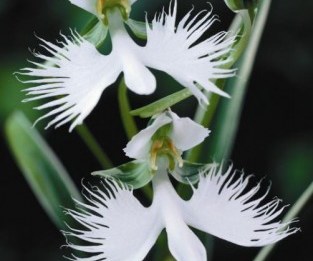
This orchid’s flower indeed looks much like a Snowy Egret with its wings wide open. Japan is home to many snowy egrets and they often share the same habitats with this little flower. This rare orchid has recently gained recognition around the world for its beauty, but ironically this species is now considered imperiled in the wild.
The leaves are similar to grass blades, between 5-20 cm long, and about 1 cm wide each. New leaves form every spring. Flowering commences in late July and peaks in August. The flower stalk holds anywhere from 1 to 8 flowers, each being around 4 cm wide. The lip, as well as the petals, are pristine white, whereas the sepals are small and greenish.
 The plant grows from a small underground tuber, no more than a couple centimeters long, Because this plant is deciduous the tuber serves as an energy source early in its growth cycle, allowing new leaves and a flower spike to form.
This species is in rapid decline over its entire range. Over collection may be a contributing factor, but for the most part the loss has been due to habitat destruction. In the distant past these plants grew in lowland bogs and marshes in the same areas where rice patties were later situated. Rice cultivation rapidly increased, taking more and more of the unique habitat, which was then followed by urbanization, and in lowland areas this species became more and more rare in the wild.
Nowadays, Habenaria radiata exists mostly in upland bogs and seepage slopes in moderate to high mountains (over 500 meters elevation). Because these areas are not considered suitable for agriculture this plant (along with other rare plants) has found its last remaining habitat in modern Japan. While it still can be found on all of Japan’s main islands it is endangered throughout its entire range and is completely gone in some areas.
Most experienced orchid growers find it quite difficult to keep for more than a season or two. This orchid requires conditions not easily duplicated outside it’s natural environment. Because this orchid is endangered one would hope that orchid growers would recognize the need to stop collecting them from the wild so we can keep as many of them alive in their native environments. We should be grateful we can enjoy these orchids vicariously through photographs, and hope we can preserve these unique and beautiful orchids for generations to come.



 San Fernando Valley Orchid Society
You must be logged in to post a comment.